
The most common surfboard-buying mistake has nothing to do with specs. It happens before the buyer opens a single sizing chart: they picture themselves surfing in six months instead of where they actually are today. What looks right and what works for your level are often not the same board. Here is how to make that decision clearly.
The One Question to Answer Before Anything Else
Before volume ratios, board shapes, or construction materials, one question needs an honest answer: what is my actual level right now?
Not your level after a few more sessions. Not the level you were at last summer. Where are you today, on a typical session, in average conditions?
This matters because every board recommendation is built around a skill stage. Get that wrong and the rest of the criteria become noise. Three reference points:
- Beginner: You are still working through whitewash. Your pop-up is inconsistent. You have not caught a green wave on purpose yet.
- Intermediate: You are catching unbroken waves with some regularity. You can control your direction. You are starting to think about turns.
- Advanced: You are surfing green waves comfortably, generating your own speed, and actively working on maneuvers.
Most people place themselves one stage higher than they should. That one stage of overconfidence is behind most bad board purchases.
The Numbers That Actually Matter
Once the skill level is clear, four measurements govern every board decision.
Volume in liters is the most important number on any board. It determines how well the board floats, how easily it paddles, and how much room for error you have when conditions are imperfect. More volume means more stability and easier wave-catching. Less volume means more sensitivity and significantly more work to paddle and get up to speed to catch waves. Which leads to early fatigue in surf sessions.
The standard reference point is a volume-to-weight ratio:
| Skill level | Recommended ratio |
| Beginner | 0.55 to 0.65 liters per kg of body weight |
| Intermediate | 0.40 to 0.55 liters per kg of body weight |
| Advanced | 0.30 to 0.45 liters per kg of body weight |
A 75 kg beginner needs roughly 41 to 49 liters of volume. A 75 kg advanced surfer might ride 25 to 34 liters. The gap is significant, and it explains why those two surfers cannot simply swap boards.
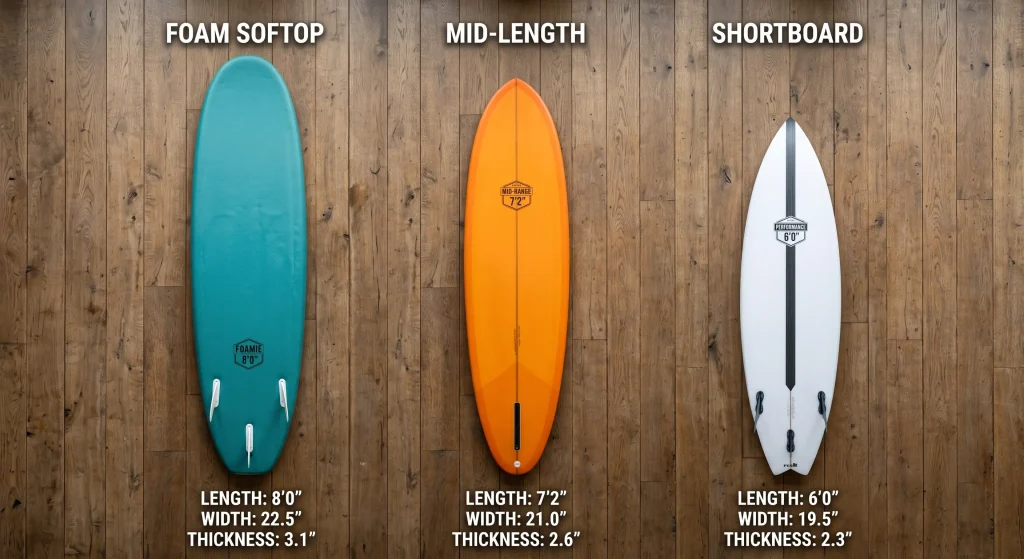
Length affects paddle power and glide. Longer boards catch waves earlier and with less physical effort. Width affects stability: a wider board is harder to tip during the pop-up. Thickness contributes to overall buoyancy and keeps the board higher in the water.
Volume is the anchor. The other three measurements flow from it.
Board Types by Level
Each board category exists for a reason. The goal is to match your current level to the right one, not the category you are aiming for.
Foam softops: where every beginner should start
Soft-top boards are wider, thicker, and more buoyant than fiberglass boards of the same length. The foam deck is safer for the surfer and for anyone in the surrounding water. They are harder to damage and require almost no maintenance.
For a first-time surfer, a foam softop between 8 and 9 feet is the correct choice. It catches waves earlier, holds speed longer, and gives the surfer enough time and stability to actually execute a pop-up. At this stage, the whole goal is repetitions. A softop maximizes them per session.
Longboards: when you want more glide and less struggle
A fiberglass longboard between 9 and 10 feet opens a different style of surfing: more emphasis on positioning, timing, and flow rather than quick reactions. For surfers moving past the softop phase, or for anyone who prefers a more deliberate, unhurried approach to waves, a longboard rewards patience and technique.
Many experienced surfers ride longboards by choice. There is nothing remedial about them.
Mid-lengths and funboards: the honest intermediate choice
The 7 to 8.5-foot range is where a lot of real development happens. Mid-lengths and funboards combine adequate paddling ease with enough responsiveness to start working on turns and wave selection. They perform across a wider range of conditions than shortboards and forgive the uneven technique that characterizes the intermediate stage.
This category is consistently underused. Many surfers skip it in a rush toward shortboards and spend months paying for that decision in plateau time.
Shortboards: when you are actually ready
Shortboards are high-performance tools. They are shaped for surfers who generate their own speed, read waves precisely, and have the paddle fitness to compete for waves in a real lineup. Below that level, they are obstacles. They catch fewer waves, forgive fewer mistakes, and punish every gap in technique immediately.
The right time to ride a shortboard is when your current board feels genuinely limiting, not when you are tired of looking at your bigger one.
The Mistake Almost Every Beginner Makes
The most expensive board decision is not the price of the board itself. It is the months of lost progression that come with choosing the wrong one.
Most beginners buy a board that reflects who they want to be as a surfer, not who they are right now. They see a shortboard and associate it with ability. They see a foam softop and associate it with being a beginner. So they buy something in between, usually too small and too narrow, and spend the next season fighting it.
A board that is too small for your level does not push you to improve. It removes the repetitions you need to improve. Fewer waves per session means slower development. It also forces compensation habits: leaning too far forward to generate speed, rushing the pop-up, guessing at timing instead of reading it. Those habits outlast the board.
Choosing a board that honestly fits your current level is not a concession. It is the fastest path to the next one.
Construction: Foam, Fiberglass, or Epoxy?
Three construction types dominate the market, each with genuine trade-offs:
Foam softop
- Most durable for everyday use and surf travel
- Safer in crowded or shallow lineups
- Heavier and less responsive than hard boards
- Best for: complete beginners, young surfers, anyone who surfs occasionally
Fiberglass (polyester resin)
- The standard for most performance boards
- More flex underfoot and a livelier feel
- Dings easily and requires regular maintenance
- Best for: intermediate to advanced surfers willing to look after their equipment
Epoxy
- Lighter and more resistant to damage than traditional fiberglass
- Stiffer feel, which works well in weaker or smaller waves
- Floats higher in the water, which helps when paddling power is still developing
- Best for: all levels in small-wave or warm-water environments, surfers with limited storage
For most beginners and many intermediates, the honest sequence is: a quality foam softop first, then a well-shaped fiberglass or epoxy mid-length once the fundamentals are consistent and the pop-up is automatic.
How Wave Conditions Change Everything
A board is matched to a surfer in specific waves, not to a surfer in the abstract. This is the variable most buying guides ignore completely.
In powerful, fast-breaking beach breaks, a board with more rocker handles the steep take-off. In slow, rolling waves, a flatter rocker and more volume keep the board moving through sections where a higher-performance shape would stall. A wide funboard that works beautifully in waist-high rollers will feel like a bus in double-overhead surf. The reverse is equally true.
At Popoyo on Nicaragua’s Pacific coast, the conditions create a specific equation worth understanding. The swell arrives in consistent, well-organized sets driven by southern hemisphere storms. Water temperature stays warm year-round, which means no wetsuit, no added bulk, more direct feedback from the board, and more freedom on the pop-up. Multiple breaks of different character sit within minutes of each other: gentle beach breaks for beginners, faster and more demanding waves for surfers ready to push their range.
That variety matters when choosing a board. A mid-length with enough volume to paddle comfortably at the softer breaks will still engage properly at the faster spots. A shortboard at the same volume level will work the faster breaks well but frustrate the same surfer when conditions ease off.
Understanding where you will actually surf is part of the equation. The Nicaragua Surf Guide covers Popoyo’s breaks, seasonal patterns, and what each spot demands at different swell sizes.
Why the Best Board Choice Starts With a Conversation
Volume ratios and board type charts are useful starting points. They are not a complete answer.
The right board for you depends on your height, your weight, your base fitness, your paddle strength, how often you surf, the specific breaks you will ride, and the technique habits you have already built. A formula cannot hold all of that at once. Someone who has watched you surf can.
An experienced coach will give you more accurate board guidance in ten minutes than a sizing chart provides in an hour. They have seen what happens when surfers at your stage ride boards that are slightly too small, slightly too narrow, or shaped for a different wave type than you are actually surfing. They know the patterns because they have watched them repeat.
At Nicaragua Surf Camp, equipment choice is part of the coaching conversation from the beginning. We do not hand every beginner the same board. We look at the person in front of us, consider the conditions that week, and give a recommendation based on both. That applies whether you are arriving with your own quiver or deciding what to ride during your stay.
The coaching team has spent years watching surfers develop at Popoyo. That context makes the board conversation more specific and more useful than anything a general guide can offer. If you are planning a stay and want equipment guidance factored in from day one, the details of how each week is structured are on the surf packages page.
Choosing Your Surfboard: A Quick Reference by Level
Three questions to answer before any purchase:
- What is my honest skill level? Beginner, intermediate, or advanced based on today, not a target.
- What waves will I be surfing? Slow and rolling, fast and steep, small and consistent, or variable?
- How often do I surf? Frequent access means you can manage less volume. Occasional surfing means you need more float to stay in practice shape.
Then match to the right category:
- Total beginner: Foam softop, 8 to 9 feet, volume at the higher end of the beginner ratio
- Beginner building consistency: Foam softop or fiberglass longboard, 9 to 10 feet
- Intermediate (catching green waves regularly): Mid-length or funboard, 7 to 8.5 feet, fiberglass or epoxy
- Advanced: Shortboard chosen with a shaper or coach who has seen you surf
When in doubt between two options, choose the one with more volume. A board with slightly too much float still gets ridden. A board with too little stays on the rack.