
You have decided to learn to surf, and somewhere in the research you keep landing on Nicaragua. But what does learning here actually involve? This guide walks through what to expect: the conditions, how fast you progress, where to surf, when to come, how to stay safe, and what gear you need.
Why Nicaragua Works for Beginner Surfers
Most world-class surf destinations are not beginner-friendly. Nicaragua is the rare exception, and it comes down to one thing: the wind. Trade winds blow offshore for around 300 days a year, holding wave faces clean and predictable instead of choppy and windblown. The swell arrives, the wind grooms it, and the water stays warm enough to surf in boardshorts year-round.
What Level Do You Need to Start?
None. You do not need any surfing experience to start here.
What you do need: basic swimming ability in open water, reasonable physical fitness, and a realistic mindset about what the first few days involve. Surfing is physically demanding. Paddling works your shoulders and back in ways most people are not used to. Expect to be tired.
If you are comfortable in the ocean, not panicked by waves washing over you, and willing to fall repeatedly without frustration, you are ready. The learning curve is steep at the start, and then it opens up.
The First Few Sessions: What Actually Happens
Session one does not start in the water. It starts on the beach, on a board lying flat in the sand. Before you paddle out, you learn the pop-up: the movement that takes you from lying on your board to standing in one fluid motion. You drill it on land until it becomes automatic, because in the water you will not have time to think about it.
Then you paddle out into the whitewash, the broken waves close to shore. No lineup, no reading sets, no timing. Just learning to feel the board under you and finding your balance on moving water. Most people catch their first wave in this first session. Standing on it, even briefly, is a different matter.
Expect to fall. A lot. That is not failure; it is the process.
What You’ll Work On
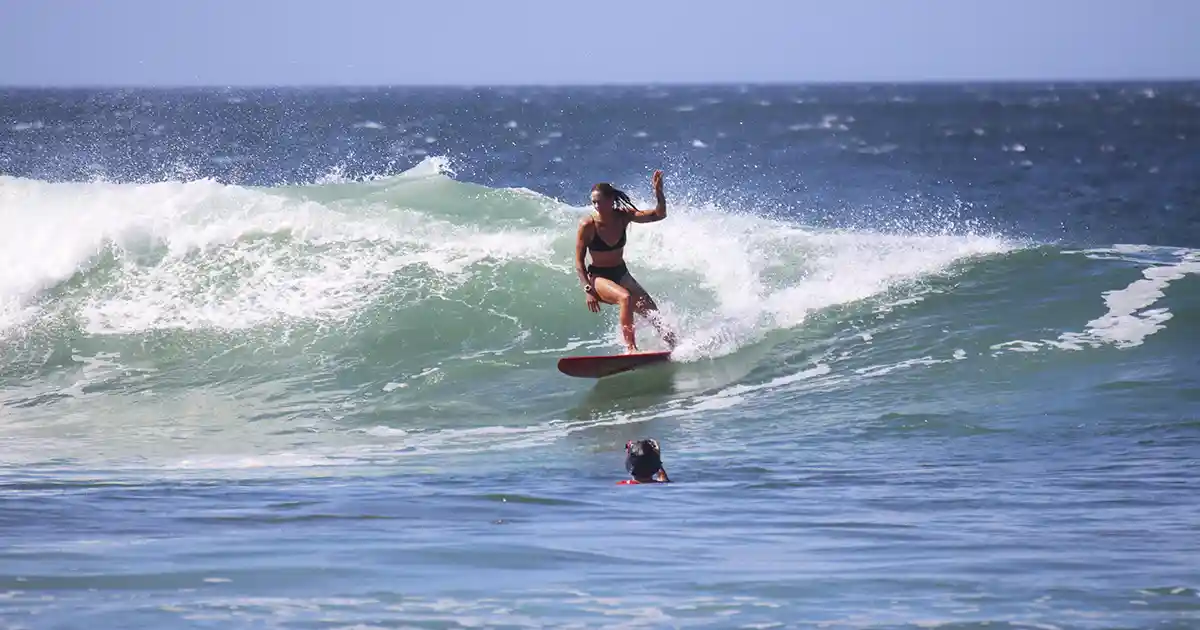
Beginner instruction covers a clear set of foundations:
- Paddling technique: arm position, head position, board trim
- Pop-up timing: reading the push of the wave, not moving too early or too late
- Stance and balance: foot placement, weight distribution, keeping your eyes up
- Wave selection: which waves to go for, which to let pass
- Positioning: where to sit relative to where waves break
- Ocean awareness: reading sets, understanding current, knowing when to hold back
These are not concepts you master in one session. They build across your time in the water.
A Week in the Water: The Progression Arc
Most people arrive with no clear picture of what a learning week actually looks like. Here is an honest one.
| Day | Focus | What changes |
| Day 1 | Pop-up on land, whitewash waves | First feel for the board and balance |
| Day 2 | Small broken waves | Paddle timing, reading the push |
| Day 3 | First unbroken waves | Wave selection starts to matter |
| Day 4-5 | Positioning, stance refinement | More waves caught, more control |
| Day 6-7 | Reading sets, longer rides | Starts to feel like surfing |
The jump from day 1 to day 7 is significant for most people, but it is not always linear. Day 3 is often harder than day 2. Fatigue, muscle soreness, and frustration are part of the arc. The surfers who progress fastest are the ones who stay patient through the difficult middle days.
Video analysis between sessions accelerates this. Watching your own pop-up from the shore changes what you understand about what you are actually doing wrong.
The Best Spots to Learn in Nicaragua
The Popoyo area concentrates most of what beginners need within a short distance: beach breaks with sandy bottoms, manageable currents on moderate swell days, and enough variation to step up as your level improves.
Absolute beginners: The beach breaks closest to shore, where waves are small, broken, and forgiving. No reef, no sharp entries, no strong lateral current pulling you sideways.
A few sessions in: The outer beach peaks, where you start reading unbroken sets and working on wave selection. Still sandy bottom, still forgiving, but with more power and more decision-making required.
Not for beginners: Popoyo reef. It is one of the best left-hand reef breaks in Central America, fast and consistent, and it is not where you start. The wave is powerful, the reef is shallow, and the people in the water know what they are doing. Respect the progression.
The Popoyo area covers several other breaks beyond the main beach access point, each suited to different stages of progression. For a full breakdown of waves, reef conditions, and what to expect at each spot, see the Nicaragua Surf Guide.
When to Come
Both main seasons offer something, depending on your starting point.
| Period | Conditions | Best for |
| December to April | Smaller, cleaner surf. Consistent offshore winds. Dry season. | Absolute beginners, first-timers |
| May to July | Swell picks up. Mix of sizes. Still manageable. | Beginners with a few sessions behind them |
| August to November | Bigger, more powerful swell. Rainy season. | Intermediate to advanced surfers |
December to April is the most comfortable entry point. The waves are smaller and the offshore wind is reliable, which means cleaner faces and easier wave reading. If you have never surfed before, this is the window to book. For current swell and wind conditions before you commit to dates, check the live surf report.
Ocean Safety: What Every Beginner Should Know
Nicaragua’s Pacific coast is not a dangerous place to surf, but it is the ocean. Conditions change. Understanding a few basics before you paddle out matters.
Rip currents are the most common hazard: channels of water moving away from shore faster than you can paddle against them. If you are being pulled out, do not fight it head-on. Paddle across the current, parallel to the beach, until you are clear of the pull, then come in. If you want to go deeper on how rip currents behave before your trip, NOAA’s rip current safety guide is the clearest public reference available.
Reading conditions is something your instructor covers before each session. Some days are not right for beginners, regardless of what the forecast looked like the night before. That call is made at the water’s edge, not online.
Getting caught inside (behind breaking waves when a large set arrives) is uncomfortable but manageable. Hold your board, take the wave on your chest or back, and wait it out. Panic makes it significantly worse.
None of this is meant to feel alarming. It is preparation. The more you understand before you paddle out, the calmer and more effective you will be once you are in the water.
Gear: What You Need and What’s Provided
Nicaragua is one of the easiest surf destinations for gear logistics. Water temperature sits around 27-29°C year-round, so no wetsuit is needed.
Provided at the camp:
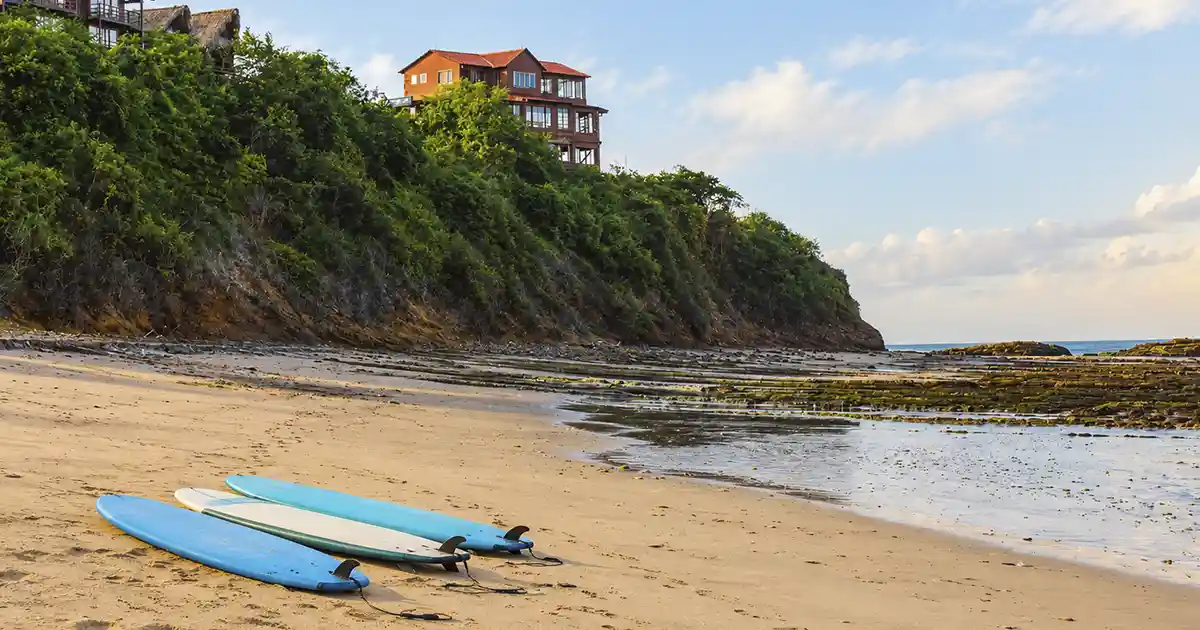
- Beginner-appropriate soft-top surfboards
- Leashes
- Board wax
Bring yourself:
- Boardshorts or bikini
- Your own rash guard if you have one
- Reef-safe sunscreen (standard chemical sunscreen is damaging to marine ecosystems and increasingly restricted in surf destinations)
- Water shoes if you have sensitive feet
One note on boards: do not arrive expecting to learn on a performance shortboard. Beginner progression happens on volume, wider and thicker boards that float well, paddle easily, and catch waves with less effort. The board choice is not a compromise; it is the right tool for the stage you are at.
Making the Most of Your Time in the Water
A few things worth knowing before your first session:
- Paddle earlier than you think. Most beginners miss waves because they start paddling too late. The moment a wave looks catchable, it is already almost past you. Commit early.
- Look where you want to go. Your body follows your eyes. Staring at the nose of the board is the fastest way to go straight into the water.
- Count the sets. Waves arrive in patterns. Watch from the beach for a few minutes before paddling out. Identify where waves break most consistently, and put yourself there.
- Rest between sets. Paddling through fatigue produces bad technique. A short sit in the lineup to recover means better attempts on the next wave.
- More waves, not bigger waves. Volume of attempts is what builds the skill. Ten small waves in a session will teach you more than two large ones.
FAQs
Do I need to know how to swim?
Yes. You do not need to be a strong swimmer, but you need to be comfortable in open water, able to swim a reasonable distance if you lose your board, and not panicked when submerged. Basic swimming ability is non-negotiable.
Beginner sessions are kept intentionally small. Surfing is a skill sport; meaningful feedback has to happen in real time, in the water, not from the beach. Small ratios are the difference between instruction and babysitting.How many students per instructor?
Your instructor makes that call before each session based on actual conditions, not a forecast from the night before. On days when the swell is too large for a beginner to learn effectively, the session adapts: a different break, a different time slot, or additional beach work. You will not be sent into conditions that exceed your level.What if the waves are too big for me?
You do not need to be an athlete. Surfing is physically demanding, particularly in the shoulders and back, but the work itself builds the condition over the week. Basic fitness helps. Expect soreness in the first few days regardless.Can I learn to surf if I'm not in great shape?
Yes. The Popoyo area is quiet, established, and accustomed to surf travelers arriving on their own. A camp environment means you are immediately around other people with the same goal. Transport to breaks, meals, and logistics are handled, which removes the friction that makes solo travel in an unfamiliar country genuinely stressful.Is Nicaragua a good destination for solo travelers?
Ready to Start?
If this page has given you a clear picture of what to expect, the next step is straightforward. Browse the surf holiday packages, pick the dates that fit your schedule and your level, and reach out. The water is here year-round. The question is when you want to be in it.
